
By Engr. Emmanuel Okpong – Uyo, Nigeria
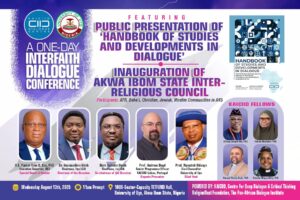
The University of Uyo on Wednesday hosted a landmark One-Day Interfaith Dialogue Conference, which featured the public presentation of the Handbook of Studies and Developments in Dialogue and the inauguration of the Akwa Ibom State Inter-Religious Council. The event brought together religious leaders, scholars, government representatives, and international guests at the 1000-Seater TETFund Hall of the University.
Organized by the KAICIID Fellows Institutional Network Handbook Public Presentation Planning Committee, in collaboration with the Pan-African Dialogue Institute (TPADI), ReligionNext Foundation, and the Centre for Deep Dialogue and Critical Thinking, the conference highlighted the growing importance of interreligious dialogue in fostering peaceful coexistence in Akwa Ibom State and beyond.
Local Government Leaders Chair the Event
The event was chaired by Dr. Uwemedimo Udoh, Chairman of Uyo Local Government Area, who praised the initiative as timely and necessary for strengthening social harmony in the state.
The Co-chairman of the Occasion, Barr. Iniobong Umah, Chairman of Ini Local Government Area, emphasized the need for collaborative platforms where faith communities can engage constructively and address shared challenges.
KAICIID Dialogue Centre Representative Delivers Keynote
A major highlight of the event was the keynote presentation by Prof. Andrew Boyd, Senior Programme Officer at the KAICIID International Dialogue Centre in Lisbon, Portugal.
Prof. Boyd underscored the critical role of interfaith dialogue in modern societies and commended the University of Uyo for taking leadership in promoting peaceful intercultural engagement.
Vice Chancellor Welcomes Participants
Welcoming participants, the Vice Chancellor of the University of Uyo, Prof. Nyaudoh Ndaeyo, served as the Chief Host. He reaffirmed the university’s commitment to championing academic contributions to peace, dialogue, and social cohesion.
Prof. Ndaeyo noted that the growing complexities of society require institutions of higher learning to take an active role in promoting initiatives that bridge divides and promote unity.
Presentation of the Handbook
The conference also featured the public unveiling of the new publication, Handbook of Studies and Developments in Dialogue, edited by KAICIID Fellows and practitioners across Africa.
The General Editor, Associate Professor. Effiong Joseph Udo, Deputy Director of the Centre for Deep Dialogue and Critical Thinking, described the book as “a comprehensive contribution to dialogue studies and a practical guide for fostering interreligious and intercultural understanding across the continent.”
The handbook captures African-led perspectives on conflict transformation, dialogue facilitation, and peacebuilding.
Inauguration of the Akwa Ibom State Inter-Religious Council
A key outcome of the event was the formal inauguration of the Akwa Ibom State Inter-Religious Council, bringing together representatives from:
-
African Traditional Religion (ATR)
-
The Bahá’í community
-
Christian denominations
-
The Jewish community
-
Muslim communities in Akwa Ibom
The council is expected to function as a collaborative platform for interfaith engagement, advisory interventions, and peacebuilding initiatives across the state.
Speakers described the inauguration as an important milestone for institutionalizing interfaith cooperation in Akwa Ibom.
International and Local Participation
The event attracted KAICIID Fellows from within and outside Nigeria, including Fatima Abubakar, Samuel Sixtus Onuh, and Scholar Wayua Kiilu. They emphasized the need for homegrown dialogue models that reflect Africa’s religious diversity and cultural realities.
Participants from diverse faith backgrounds contributed to discussions on strengthening local structures for conflict mitigation, promoting tolerance, and deepening research on interreligious relations.
Strengthening the State’s Peace Architecture
Organizers expressed optimism that the new Inter-Religious Council will enhance the state’s peace architecture by creating open channels of communication among religious communities.
The conference concluded with commitments from stakeholders to sustain ongoing dialogue efforts and support future joint initiatives.