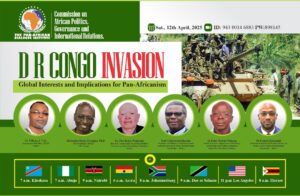
On Saturday, 12th April 2025, the Commission on African Politics, Governance and International Relations under The Pan-African Dialogue Institute (TPADI) convened an influential and deeply engaging webinar on one of Africa’s most urgent geopolitical crises: the ongoing invasion and destabilization of the Democratic Republic of Congo (DRC).
The theme:
“D.R. Congo Invasion: Global Interests and Implications for Pan-Africanism”
brought together eminent scholars, international relations experts, Pan-African thought leaders, and policy analysts to dissect the external forces shaping the conflict and the consequences for continental unity, sovereignty, and security.
The event, held via Zoom across multiple time zones—from Kinshasa to Abuja, Nairobi, Accra, Johannesburg, Harare, and Los Angeles—attracted participants from across Africa and the diaspora. The high level of turnout and engagement demonstrated the timeliness and importance of this conversation for the Pan-African community.
Opening Reflections
The webinar was opened by Dr. Effiong J. Udo, International President of TPADI. He emphasized that the crisis in the D.R. Congo is not merely a national issue but a continental one, rooted in complex histories of colonial exploitation, geopolitical interests, and Africa’s ongoing struggle for true independence.
He called on African intellectuals, policymakers, and citizens to look beyond media narratives and confront the deeper structural forces driving the conflict.
Key Contributions from Panelists
Mutombo Nkulu-N’Sengha, Ph.D
Vice President, TPADI
Prof. N’Sengha provided a gripping, contextual historical analysis of the DRC crisis—tracing the roots of foreign interference, exploitation of mineral wealth, and systematic destabilization. He emphasized that Congo’s suffering is a reflection of Africa’s unfinished liberation.
Dr. Pius Kabut Wanyonyi
Director, Commission on African Politics, Governance and International Relations (Kenya)
Dr. Wanyonyi examined how global superpowers and multinational corporations manipulate African conflicts for geopolitical dominance and resource extraction. He argued that until Africa builds collective defense and economic systems, its nations will continue to be battlegrounds for global interests.
Prof. G. Macharia Munene
Professor of History and International Relations, United States International University–Africa
Prof. Munene interrogated media narratives surrounding the DRC conflict, exposing how information warfare contributes to instability. He urged Africans to invest in independent research, documentation, and media institutions capable of telling Africa’s stories from African perspectives.
Dr. Peter Wafula Wekesa
Senior Lecturer, Department of History, Archaeology & Political Studies, Kenyatta University
Dr. Wekesa presented a scholarly view of the regional complexities—highlighting the roles played by neighboring states, regional alliances, and historical grievances. His analysis stressed the urgency of coordinated regional diplomacy.
Dr. Francis Kihuyandi
Assistant Professor of International Law, United States International University–Africa
Dr. Kihuyandi explored the legal dimensions of foreign intervention in the DRC. He emphasized the need for African nations to strengthen continental legal frameworks, use international law strategically, and pursue justice for affected populations.
Key Themes That Emerged
Across the presentations, several critical themes became evident:
1. Congo’s Crisis Is Africa’s Crisis
Panelists agreed that the DRC’s destabilization represents a broader, continental vulnerability to external exploitation.
2. The Struggle Over Natural Resources Is Central
Africa’s minerals—cobalt, coltan, gold, lithium—remain at the heart of global power struggles. Without African control, conflict becomes inevitable.
3. Weak Regional Institutions Fuel Instability
The lack of unified African political and security mechanisms allows external actors to manipulate internal conflicts.
4. A Pan-African Response Is Urgent
Solidarity, coordinated diplomacy, collective security arrangements, and a shared continental vision are essential for long-term peace.
5. Information Control Is Part of the War
Participants were urged to critically examine global media narratives and develop African-centered scholarship.
Audience Engagement
Participants across Africa and the diaspora contributed deep reflections, questions, and calls for urgent Pan-African collaboration. Many expressed that the crisis in Congo is a wake-up call for African unity, stronger institutions, and the prioritization of African interests above foreign influence.
A Call to Pan-African Action
The webinar concluded with a renewed commitment to:
-
amplify the voices of Congolese communities,
-
strengthen African diplomatic frameworks,
-
hold global actors accountable,
-
and educate citizens on the geopolitical forces shaping the continent.
The Commission on African Politics, Governance and International Relations reiterates that Africa cannot achieve peace and prosperity without solidarity. The D.R. Congo is a mirror reflecting the challenges—and opportunities—before the African continent.
In Appreciation
We extend heartfelt gratitude to all speakers, participants, and organizers whose contributions made this session a powerful step toward a more conscious, united, and action-driven Pan-African community.
The struggle for Africa’s sovereignty continues—and together, we rise.