
By Engr. Emmanuel Okpong
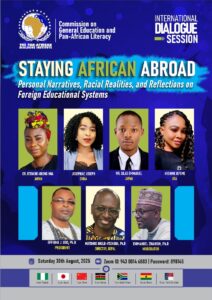
On Saturday, 30th August 2025, the Commission on General Education and Pan-African Literacy of The Pan-African Dialogue Institute (TPADI) hosted a deeply reflective and emotionally resonant International Dialogue Session on the theme:
“Staying African Abroad: Personal Narratives, Racial Realities, and Reflections on Foreign Educational Systems.”
Participants connected from Nigeria, Japan, China, Kenya, South Africa, Ghana, and the USA to engage in a rich, multigenerational, and Pan-African discussion about identity, belonging, racial experiences, and cultural resilience in foreign academic environments.
The event created a rare space where Africans in the diaspora shared lived experiences and intellectual reflections that are rarely captured in mainstream discourse.
Opening Reflections
The dialogue began with welcome insights from Effiong J. Udo, Ph.D, President of TPADI, who emphasized that the African identity remains an anchor—even in the most unfamiliar and racially charged environments abroad.
He noted that African students and professionals often act as unofficial ambassadors of the continent, carrying their cultural roots into spaces that sometimes challenge, shape, or strengthen their African consciousness.
Narratives & Contributions from Speakers
Dr. Utenghe-Obong Nna (Japan)
Dr. Nna’s narrative shed light on the unique challenges and opportunities African students face in Japan. She spoke about navigating cultural differences, the discipline of Japanese society, and the subtle forms of exclusion encountered in academic and corporate spaces.
Josephine Joseph (China)
Josephine shared vivid experiences of studying in China, where language barriers, racial perceptions, and stereotypes often intersect with academic expectations. She emphasized resilience, intentional self-representation, and the importance of community among African students abroad.
Mr. Silas Emmanuel (Japan)
Silas gave a grounded perspective on life as an African male navigating foreign educational systems. He discussed racial biases, academic pressures, and the struggle to maintain cultural identity while adapting to host-country norms.
Nyenime Ikpeme (USA)
Nyenime provided a powerful reflection on studying in the United States—the complexities of race relations, the polarity of Black identity, and the daily realities of microaggressions. Her narrative reinforced the importance of African-centered confidence and emotional intelligence in Western spaces.
Expert Commentary & Scholarly Insights
Mutombo Nkulu-N’Sengha, Ph.D — Director, GEPAL
Dr. N’Sengha offered a broader philosophical and sociocultural analysis of the African diaspora experience. He explored questions of identity, historical displacement, and the psychological impact of racism on African students globally. His insights tied individual stories into the larger framework of Pan-African consciousness.
Emmanuel Zwanbin, Ph.D — Moderator
Dr. Zwanbin guided the conversation with exceptional balance—drawing connections between personal narratives and broader issues of global education, equity, and cultural diplomacy. His moderation fostered a space of openness, vulnerability, and intellectual depth.
Key Themes That Emerged
1. Identity Negotiation
Africans abroad constantly navigate the tension between assimilation and cultural preservation.
2. Racial Realities in Foreign Systems
Speakers highlighted how African students often face unique challenges—from stereotyping to institutional biases.
3. The Power of Community
Building African and Black student networks abroad serves as emotional and academic support systems.
4. Cultural Confidence as Survival Strategy
Staying grounded in African values helps students resist negative narratives and thrive academically and socially.
5. Educational Systems Shape Global Perceptions
Foreign educational institutions play a major role in shaping how Africans are seen—and how Africans see themselves.
Audience Engagement
Participants across continents shared personal reflections, including:
-
experiences with discrimination,
-
challenges of integration,
-
moments of cultural pride,
-
and strategies for maintaining African identity abroad.
The session revealed a shared desire for stronger Pan-African support networks across diaspora communities.
Conclusion: Strengthening the Global African Identity
The webinar concluded with a reaffirmation that Africans abroad are cultural diplomats, innovators, and bridge-builders. Their stories matter, and their resilience shapes Africa’s image on the global stage.
The Commission on General Education and Pan-African Literacy restated its commitment to:
-
supporting diaspora learning communities,
-
promoting Pan-African literacy,
-
encouraging intercultural engagement,
-
and amplifying African voices within global educational institutions.
This dialogue has set a foundation for deeper conversations about African identity, diaspora challenges, and global belonging.
Appreciation
We extend our gratitude to all speakers, moderators, and participants for making this dialogue richly informative and emotionally powerful.
Together, we continue the Pan-African journey—across borders, cultures, and continents.