
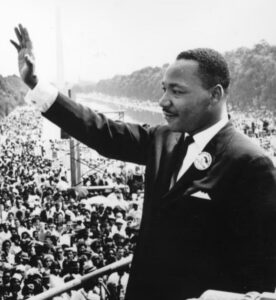
 Martin Luther King Jr. was one of the most influential civil rights leaders of the twentieth century and a global symbol of nonviolent resistance against racial injustice, segregation, and oppression. His leadership during the American Civil Rights Movement transformed the social and political landscape of the United States and inspired liberation movements across Africa and the African diaspora. King’s life and work intersected with global struggles against colonialism, racism, and economic injustice (King, 1963; Carson, 2001).
Early Life
Martin Luther King Jr. was born on January 15, 1929, in Atlanta, Georgia, United States. He was born into a deeply religious and socially conscious family. His father, Martin Luther King Sr., was a prominent Baptist minister, while his mother, Alberta Williams King, was a church organist and educator.
Growing up in the racially segregated American South, King experienced discrimination at an early age. These experiences profoundly shaped his understanding of injustice and strengthened his resolve to challenge systemic racism. His upbringing in the Black church instilled in him strong moral values, discipline, and a sense of social responsibility (Carson, 2001).
Education
King was an exceptional student and entered Morehouse College at the age of 15, where he studied sociology. At Morehouse, he was influenced by the college president, Benjamin E. Mays, who emphasized social justice and the moral responsibility of educated individuals (Garrow, 1986).
He later attended Crozer Theological Seminary, earning a Bachelor of Divinity degree, and subsequently completed his PhD in Systematic Theology at Boston University in 1955. During his studies, King was influenced by the teachings of Mahatma Gandhi, Christian ethics, and philosophical ideas on nonviolent resistance, which became central to his political strategy (King, 1963).
Career and Political Activism
Martin Luther King Jr. emerged as a national leader during the Montgomery Bus Boycott (1955–1956), which began after Rosa Parks’ arrest for refusing to give up her seat to a white passenger. As president of the Montgomery Improvement Association, King led the successful boycott, bringing national attention to the struggle against segregation (Garrow, 1986).
In 1957, King co-founded the Southern Christian Leadership Conference (SCLC), which coordinated nonviolent protests across the southern United States. Under his leadership, the movement organized landmark campaigns, including the Birmingham Campaign (1963) and the March on Washington, where King delivered his iconic “I Have a Dream” speech.
King’s activism played a pivotal role in the passage of major civil rights legislation, including the Civil Rights Act of 1964 and the Voting Rights Act of 1965. In 1964, he became the youngest recipient of the Nobel Peace Prize, awarded for his commitment to nonviolent social change.
In his later years, King expanded his focus to include economic justice, labor rights, and opposition to the Vietnam War, emphasizing the interconnectedness of racism, militarism, and poverty (King, 1967).
Contribution to Pan-Africanism and Global Liberation
Although primarily known for his work in the United States, Martin Luther King Jr. held strong Pan-African and global human rights perspectives. He recognized the shared struggle between African Americans and colonized peoples in Africa and the Global South.
King expressed solidarity with African independence movements and drew inspiration from leaders such as Kwame Nkrumah and Nelson Mandela. He viewed the civil rights struggle as part of a broader global fight against oppression and famously stated that “injustice anywhere is a threat to justice everywhere” (King, 1963).
His philosophy of nonviolence influenced liberation movements worldwide and strengthened intellectual and moral ties between the African diaspora and the African continent.
Death
Martin Luther King Jr. was assassinated on April 4, 1968, at the age of 39, in Memphis, Tennessee, while supporting a sanitation workers’ strike. His assassination sparked widespread grief, protests, and unrest across the United States and beyond.
King’s death marked a turning point in the civil rights movement, highlighting both the progress achieved and the deep resistance to racial equality. He was buried in Atlanta, Georgia, where his legacy continues to be honored through the Martin Luther King Jr. Center for Nonviolent Social Change (Garrow, 1986).
Legacy
Martin Luther King Jr.’s legacy endures as a moral beacon for justice, equality, and human dignity. His commitment to nonviolence, social justice, and global solidarity continues to inspire civil rights movements, Pan-African thought, and human rights advocacy worldwide. He remains a symbol of courage, ethical leadership, and the transformative power of principled resistance.
Source
Carson, C. (2001). The autobiography of Martin Luther King, Jr. Warner Books.
Garrow, D. J. (1986). Bearing the cross: Martin Luther King, Jr., and the Southern Christian Leadership Conference. William Morrow.
King, M. L., Jr. (1963). Why we can’t wait. Harper & Row.
King, M. L., Jr. (1967). Beyond Vietnam: A time to break silence. Riverside Church.