
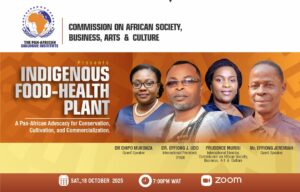
On Saturday, 18th October 2025, the Commission on African Society, Business, Arts & Culture of The Pan-African Dialogue Institute (TPADI) hosted a highly enlightening and deeply inspiring webinar on the theme:
“Indigenous Food–Health Plant: A Pan-African Advocacy for Conservation, Cultivation, and Commercialization.”
The event brought together experts, cultural scholars, health researchers, and advocates for indigenous knowledge systems to examine the critical role of African plants in health, nutrition, economic empowerment, and cultural continuity.
Participants from across the continent joined the conversation via Zoom at 7:00 PM WAT, engaging in a rich exchange of ideas on how Africa can reclaim its botanical heritage for societal well-being and sustainable development.
Opening Remarks
The session was opened by Dr. Effiong J. Udo, International President of TPADI, who highlighted the urgency of safeguarding Africa’s indigenous plants in the face of environmental degradation, Western pharmaceutical dominance, and loss of cultural identities.
He emphasized that traditional African food and medicinal plants are not relics of the past—they are powerful assets for health, economic upliftment, and cultural sovereignty.
Panel Highlights and Contributions
Dr. Chipo Mukonza — Guest Speaker
Dr. Mukonza provided a strong academic and practical perspective on the ecological and health value of indigenous African plants. She discussed the risks posed by climate change, urbanization, and foreign agricultural practices that threaten local biodiversity.
Her message was clear: Africa must prioritize conservation to protect its future.
Dr. Effiong J. Udo — International President, TPADI
Expanding on the cultural dimension, Dr. Udo reflected on how indigenous plants connect African people to ancestral knowledge and spiritual heritage. He encouraged African communities to revive traditional farming systems, herbal practices, and food-processing methods, asserting that Africa’s health revival begins with Africa’s plants.
Prudence Murisi — International Director, Commission on African Society, Business, Arts & Culture
Prudence Murisi focused on the economic potential of indigenous plants. She spoke passionately about creating value chains—from cultivation to processing and commercialization—that empower rural communities, women, and youth.
She stressed the need for regional policies and Pan-African investment structures that support indigenous plant industries.
Mr. Effiong Jeremiah — Guest Speaker
Mr. Jeremiah shared practical insights from traditional African agriculture and herbal medicine. He emphasized hands-on strategies for cultivation and the importance of passing indigenous knowledge to younger generations.
His presentation bridged traditional wisdom with modern applications.
Major Themes and Insights
Across all presentations, several powerful themes emerged:
1. Indigenous Plants Are Key to Africa’s Health Security
Speakers highlighted the nutritional and medicinal richness of African plants that are often overlooked in favor of imported foods and pharmaceuticals.
2. Conservation Is a Strategic Imperative
Environmental threats, loss of traditional farming lands, and the decline of indigenous knowledge systems pose a risk to Africa’s biological heritage.
3. Economic Empowerment Through Indigenous Value Chains
Commercializing Africa’s food-health plants—ethically and sustainably—can create jobs, support smallholder farmers, and boost intra-African trade.
4. Cultural Identity and Heritage Must Be Preserved
Indigenous food systems are deeply tied to African spirituality, ancestral practices, and community life. Protecting them is an act of cultural sovereignty.
5. Pan-African Collaboration Is Essential
Participants agreed that protecting indigenous plants requires cross-border cooperation among researchers, farmers, policymakers, and Pan-African institutions.
Audience Engagement
Attendees shared diverse insights from their regions, highlighting locally significant plants such as moringa, hibiscus, bitter leaf, baobab, African ginger, and many others.
The lively Q&A session reaffirmed the need to document African herbal knowledge, support research, and promote community-based farming systems.
Conclusion: A Renewed Pan-African Commitment
The webinar concluded with a strong collective resolve to:
-
conserve Africa’s indigenous plants,
-
promote sustainable cultivation,
-
support local farming communities,
-
and create African-led industries around indigenous foods and herbal medicine.
The Commission on African Society, Business, Arts & Culture reaffirms its commitment to advancing African knowledge systems and empowering communities through cultural and economic revitalization.
Africa’s future prosperity lies in harnessing the treasures planted in its soil—treasures passed down by generations and waiting to be rediscovered.
Acknowledgments
We extend heartfelt appreciation to our esteemed speakers, participants, and partner institutions. Your voices and contributions continue to strengthen the movement for an ecologically resilient, culturally grounded, and economically empowered Africa.
Together, we rise by reclaiming what is ours.