
By Emmanuel Okpong
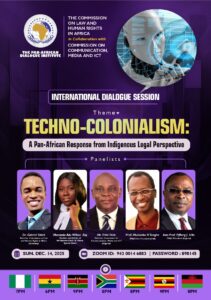
The Pan-African Dialogue Institute (TPADI), through a joint effort of its Commission on Law & Human Rights and Commission on Media, ICT & Communication, on Sunday 14th December, 2025 convened a high-level virtual dialogue titled “Techno-Colonialism: A Pan-African Response from an Indigenous Legal Perspective.”
The session brought together legal scholars, technologists, Pan-African thinkers, and institutional leaders from across Africa and the diaspora to interrogate a pressing reality: colonialism has not ended—it has evolved into the digital sphere.
Far from being a theoretical exercise, the dialogue exposed how technology, data, algorithms, platforms, and digital infrastructure are increasingly becoming tools through which power and control over Africa are exercised.
Opening the Conversation: Colonialism Beyond Ships and Guns
The dialogue opened with a foundational presentation by Dr. Gabriel Udoh, who set the intellectual tone of the session by challenging the conventional understanding of colonialism.
According to Dr. Udoh, colonialism has never been strictly about physical occupation, race, or geography. Rather, it has always revolved around power and control—who holds it, who exercises it, and who is subjected to it.
He argued that while traditional colonialism focused on the extraction of human and natural resources from the Global South to the Global North, contemporary colonialism is driven by data, digital systems, and automated decision-making.
Key Highlights from Dr. Gabriel Udoh
-
Introduced techno-colonialism as a modern extension of historical colonialism
-
Explained how African data is extracted but governed elsewhere
-
Demonstrated how algorithms marginalize Africans in recruitment, visibility, and access to opportunities
-
Shared lived experiences of algorithmic bias against African names and identities
-
Raised concerns about AI systems misrepresenting African history and knowledge
-
Warned about the silent erosion of sovereignty through automated technologies
Dr. Udoh outlined five critical layers of techno-colonial control: data, AI models, digital platforms, infrastructure, and imported regulations—arguing that Africa currently lacks control across all five.
 Indigenous Law and the Limits of Borrowed Regulations
Building on this foundation, Barrister Manassia Adu Wilson, ESQ (Ghana) delivered a deeply structured legal analysis, grounding the discussion in
indigenous African legal philosophy and Pan-African jurisprudence.
She emphasized that Africa’s digital vulnerability is worsened by the widespread adoption of foreign legal frameworks that do not reflect African realities.
Key Highlights from Barr. Manassia Adu Wilson
-
Defined techno-colonialism as digital domination that mirrors historical colonial patterns
-
Critiqued Africa’s reliance on imported legal models such as GDPR without sufficient contextualization
-
Identified major challenges including enforcement gaps, capacity constraints, and legitimacy issues
-
Emphasized African legal values such as communitarianism, Ubuntu, sovereignty, and collective responsibility
She illustrated these arguments using practical African case studies:
-
Kenya (Huduma Namba): Courts halted a biometric ID system until proper legal safeguards were enacted, demonstrating the judiciary’s role in resisting techno-colonialism.
-
Ghana (SIM Card Re-registration): Raised serious data sovereignty concerns due to dependence on foreign-owned telecom and cloud infrastructure.
-
South Africa (POPIA): Showed how strong data protection laws can limit exploitation, while also exposing enforcement and infrastructure challenges.
Barrister Manassia concluded that laws alone are insufficient—they must be enforceable, culturally legitimate, and supported by African-owned infrastructure.
 Techno-Colonialism as a Continuation of Africa’s Historical Subjugation
Mr. Etim Etim offered a powerful historical and political intervention, situating techno-colonialism within a broader continuum of African exploitation.
He argued that Africa has moved through successive phases of colonial domination:
-
Political colonialism
-
Economic colonialism
-
Military colonialism
-
Psychological and mental colonialism
-
And now, technological colonialism
Key Highlights from Mr. Etim Etim
-
Described techno-colonialism as an extension, not a replacement, of older colonial systems
-
Highlighted contemporary examples of foreign involvement in African governance systems
-
Raised alarm over external auditing and AI-driven decision-making in national institutions
-
Stressed that ignorance among African leaders poses a greater threat than technology itself
He emphasized that without awareness at the leadership level, Africa risks repeating historical mistakes under new digital guises.
Global Power, Technology, and Africa’s Marginal Position
From the diaspora perspective, Professor Mutombo Nkulu-Nsengha, speaking from the United States, placed the discussion within the context of global political economy and technological power.
His intervention underscored the uncomfortable reality that Africa remains marginal in the global economy despite its vast resources, while digital power is concentrated in a few global centers.
Key Highlights from Prof. Mutombo Nkulu-Nsengha
-
Connected techno-colonialism to global economic imbalance and technological dependency
-
Highlighted how surveillance, sanctions, and digital platforms are used to discipline weaker states
-
Warned about information warfare, AI-driven misinformation, and digital manipulation of elections
-
Called for the inclusion of scientists, technologists, and economists in future Pan-African dialogues
He made a strong case for long-term structural solutions, including the establishment of a Pan-African University to build continental consciousness, foster innovation, and reduce dependency on foreign systems.
Presidential Reflections: Awareness as the First Line of Defense
In his concluding remarks, the President of the Pan-African Dialogue Institute synthesized the contributions of all speakers and emphasized the urgency of sustained engagement.
He acknowledged that while immediate solutions may be limited, awareness creation is itself a form of resistance.
Key Highlights from the TPADI President
-
Affirmed that techno-colonialism threatens African dignity, identity, and sovereignty
-
Stressed that Africa must not remain a passive consumer of foreign technologies
-
Called for continuous dialogue rather than one-off events
-
Emphasized collaboration with Africans in the diaspora
-
Highlighted the critical role of youth, universities, and professionals
He urged the Institute to treat the webinar as an entry point, not a conclusion, to a broader continental conversation.
What the Dialogue Revealed
Across all contributions, several key truths emerged:
-
Techno-colonialism is already shaping African lives
-
Control over data and technology equals control over sovereignty
-
Imported laws without enforcement are ineffective
-
Indigenous African values must inform digital governance
-
Courts, scholars, technologists, and youth all have roles to play
Most importantly, the dialogue made clear that Africa’s digital future cannot be outsourced.
Conclusion: From Awareness to Action
The TPADI dialogue on techno-colonialism was not merely an academic exchange—it was a call to consciousness.
Technology is not neutral. Algorithms are not innocent. Platforms are not benevolent. They reflect the values and interests of those who design and control them.
If Africa does not deliberately define its digital future, others will continue to define it on its behalf.
Through Pan-African unity, indigenous legal wisdom, sustained awareness, and strategic collaboration, Africa can begin to reclaim its digital sovereignty—not tomorrow, but starting now.
Watch Full Replay here