
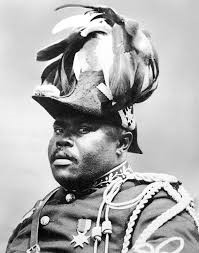
 Marcus Mosiah Garvey was one of the most influential Pan-African thinkers and Black nationalist leaders of the twentieth century. He was a central figure in the global movement for Black self-determination, economic independence, and African unity. Garvey’s ideas shaped Pan-Africanism long before the independence of African states and profoundly influenced later leaders such as Kwame Nkrumah, Malcolm X, and other liberation thinkers across Africa and the African diaspora (Martin, 1983).
Early Life
Marcus Garvey was born on August 17, 1887, in St. Ann’s Bay, Jamaica, then a British colony. He was the youngest of eleven children born to Marcus Mosiah Garvey Sr., a mason, and Sarah Jane Richards, a domestic worker. Garvey grew up in a racially stratified colonial society that reinforced white supremacy and limited opportunities for Black people (Cronon, 1960).
As a young boy, Garvey was exposed to books and political discussions, developing early intellectual curiosity. His experiences of racial discrimination in Jamaica and later in Central America deeply influenced his worldview and commitment to Black liberation.
Education
Garvey received limited formal education, attending elementary school in Jamaica before beginning an apprenticeship as a printer. Through his work in printing and journalism, he became largely self-educated, reading extensively on history, politics, and African civilization (Martin, 1983).
In his early adulthood, Garvey traveled throughout the Caribbean and Central America, where he observed the exploitation of Black workers under colonial and capitalist systems. These experiences strengthened his belief in the necessity of Black unity and economic self-reliance.
Career and Political Activism
In 1914, Garvey founded the Universal Negro Improvement Association and African Communities League (UNIA-ACL) in Jamaica, with the aim of promoting Black pride, unity, and self-sufficiency. In 1916, he moved the organization’s headquarters to the United States, where the UNIA grew into the largest mass movement of Black people in history, with millions of members worldwide (Cronon, 1960).
Garvey launched initiatives such as the Negro World newspaper and the Black Star Line, a shipping enterprise intended to facilitate Black economic independence and global trade. Although the Black Star Line ultimately failed due to mismanagement and political opposition, it symbolized Garvey’s vision of economic empowerment.
Garvey’s growing influence attracted intense scrutiny from U.S. authorities. In 1923, he was convicted of mail fraud, a charge widely regarded as politically motivated. He was imprisoned and later deported to Jamaica in 1927, effectively ending his influence in the United States but not his global impact (Martin, 1983).
Contribution to Pan-Africanism
Marcus Garvey is widely regarded as the father of modern Pan-African mass mobilization. His philosophy emphasized African pride, cultural revival, economic independence, and the redemption of Africa from colonial rule. Garvey famously declared, “Africa for the Africans, at home and abroad.”
Garvey’s ideas influenced African nationalist movements and leaders, particularly Kwame Nkrumah, who acknowledged Garvey’s ideological impact on his vision of African unity. Garvey’s emphasis on self-reliance, Black consciousness, and global African solidarity laid the ideological foundation for later Pan-African and Black liberation movements (Adi & Sherwood, 2003).
Death
Marcus Garvey died on June 10, 1940, at the age of 52, in London, England, after suffering a stroke. He died in relative obscurity, yet his death marked the end of a life that had reshaped global Black consciousness.
In 1964, his remains were returned to Jamaica, where he was declared Jamaica’s first National Hero. His legacy continues to resonate across Africa and the African diaspora (Martin, 1983).
Legacy
Marcus Garvey’s legacy endures as a powerful call for African unity, dignity, and self-determination. His ideas continue to inspire Pan-African thought, Black nationalism, cultural renaissance movements, and struggles for economic justice. Garvey remains a towering figure in the intellectual and political history of Pan-Africanism.
Sources
Adi, H., & Sherwood, M. (2003). Pan-African history: Political figures from Africa and the diaspora since 1787. Routledge.
Cronon, E. D. (1960). Black Moses: The story of Marcus Garvey and the Universal Negro Improvement Association. University of Wisconsin Press.
Martin, T. (1983). Race first: The ideological and organizational struggles of Marcus Garvey and the Universal Negro Improvement Association. Greenwood Press.