
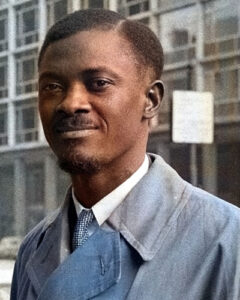
 Patrice Émery Lumumba was one of Africa’s most iconic nationalist leaders and a powerful symbol of the struggle against colonialism and neo-colonial domination. As the first democratically elected Prime Minister of the Democratic Republic of the Congo (DRC), Lumumba emerged during a critical period of African decolonization. His life and leadership reflected the aspirations, contradictions, and challenges of post-colonial Africa, particularly the quest for genuine political and economic independence (Nzongola-Ntalaja, 2002).
Early Life
Patrice Lumumba was born on July 2, 1925, in Onalua, in the Kasai region of the then Belgian Congo. He was born into a modest family of the Tetela ethnic group. His early life was shaped by the harsh realities of Belgian colonial rule, which imposed racial hierarchy, forced labor, and limited opportunities for Africans (De Witte, 2001).
Lumumba showed intellectual curiosity and ambition from an early age. Despite limited access to education, he distinguished himself through self-study, discipline, and a strong sense of justice, qualities that would later define his political leadership.
Education
Lumumba received his early education at Catholic missionary schools, where he was trained under a rigid colonial curriculum designed to produce clerks rather than independent thinkers. He later attended a Protestant mission school, where he developed advanced literacy and rhetorical skills (Nzongola-Ntalaja, 2002).
Although Lumumba did not attend a university in the conventional sense, he was largely self-educated, reading extensively in political philosophy, African history, and anti-colonial literature. His intellectual growth was influenced by Pan-African ideas, socialist thought, and the writings of African and Black diasporic leaders.
Career and Political Activism
Lumumba began his professional career as a postal clerk, one of the few positions available to educated Congolese under colonial rule. His exposure to systemic discrimination radicalized his political consciousness. He later worked as a journalist and became actively involved in political organizing.
In 1958, Lumumba founded the Mouvement National Congolais (MNC), a nationalist political party that sought a united, independent Congo free from ethnic fragmentation and foreign control. Unlike other parties rooted in regional or ethnic identities, the MNC promoted national unity and Pan-African solidarity (De Witte, 2001).
Lumumba gained international prominence after attending the All-African Peoples’ Conference in Accra in 1958, hosted by Kwame Nkrumah. This event strengthened his Pan-African convictions and aligned him with other African liberation leaders.
Following Congo’s independence on June 30, 1960, Lumumba became Prime Minister. His historic independence speech, in which he openly condemned colonial exploitation, marked a decisive break from colonial subservience and asserted African dignity on the global stage (Nzongola-Ntalaja, 2002).
However, his tenure was short-lived. Political instability, foreign interference, and internal divisions—particularly the secession of Katanga—undermined his government. With the involvement of Belgian authorities and Western powers during the Cold War, Lumumba was dismissed, arrested, and eventually transferred to Katanga.
Contribution to Pan-Africanism
Patrice Lumumba was a committed Pan-Africanist who believed that Africa’s independence would remain fragile without unity and resistance to imperialism. He viewed Congo’s struggle as inseparable from the liberation of the entire African continent (Nkrumah, 1963).
Lumumba advocated African solidarity, non-alignment, and collective resistance to neo-colonial domination. His vision aligned closely with the Pan-African ideals of leaders such as Kwame Nkrumah and Gamal Abdel Nasser. Though his time in power was brief, Lumumba’s ideas and courage inspired liberation movements across Africa and the African diaspora.
Death
Patrice Lumumba was assassinated on January 17, 1961, at the age of 35, in Katanga Province, with the complicity of Belgian officials and the involvement of foreign intelligence agencies. His body was secretly disposed of in an attempt to erase his memory, though his ideas survived (De Witte, 2001).
Lumumba’s assassination shocked the African continent and the world, symbolizing the violent suppression of African self-determination during the Cold War. In later years, Belgium formally acknowledged its moral responsibility for his death.
Legacy
Patrice Lumumba remains one of Africa’s most powerful martyrs of independence. He is remembered as a fearless advocate of African dignity, unity, and sovereignty. His name endures as a symbol of resistance against imperialism and a rallying point for Pan-African consciousness across generations.
Source
De Witte, L. (2001). The assassination of Lumumba. Verso.
Nkrumah, K. (1963). Africa must unite. Heinemann.
Nzongola-Ntalaja, G. (2002). The Congo from Leopold to Kabila: A people’s history. Zed Books.