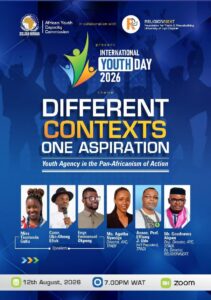
 To mark International Youth Day 2026, the African Youth Capacity Commission of The Pan-African Dialogue Institute, in collaboration with the Religion Next Foundation for Youth and Peace Building (University of Uyo Chapter), hosted a transformative virtual gathering. Centering on the global theme Different Contexts, Common Aspirations, the webinar contextualized the discussion around Youth Agency in the Pan-Africanism of Action. The event served as a major highlight following the Institute’s milestone declaration of 2025–2035 as the Youth Decade—a ten-year commitment to recognize, celebrate, and systematically empower young leaders across Africa and the diaspora.
Here is a full recap of the key insights, historical lessons, and forward-looking strategies shared by the speakers during the session.
1. Opening & Welcome Remarks: Reclaiming Present Leadership
The session kicked off with an inspiring opening by Goodnews Akpan (Moderator/Director), who grounded the event in the historic mandate of International Youth Day and reminded attendees of a foundational truth: “Build the youth, build the nation.” Joining from Uganda, Nyesiga, Agatha, Director of the African Youth Capacity Commission, welcomed participants across the continent. She celebrated the resilience of African youth, framing them not as passive beneficiaries, but as the active agents of systemic change driving Africa’s developmental agenda. Officially opening the webinar, Assoc. Prof. Efiong Udo, International President of The Pan-African Dialogue Institute, delivered a powerful charge to the audience. He urged young Africans to stop waiting for permission to lead or viewing themselves merely as “leaders of tomorrow.” Instead, he called on the youth to step confidently into their roles as leaders of the present, standing firm against both internal misgovernance and external exploitation.
2. Keynote Presentations & Session Highlights
Session 1: Youth Agency in Pan-Africanism: Lessons from History: Comrade Ukobong Efiok (President-Elect, Dept. of History & International Studies, Univ. of Uyo; Founder, Africa Report Files) anchored the historical foundation of youth-led movements across the continent. Drawing direct parallels between past struggles and modern challenges, he pointed out that youth agency is not a new concept in Africa—it is the very engine that powered independence.
-
Historical Precedents: He highlighted trailblazers like Tom Mboya, who was just 28 years old when he keynoted and chaired the historic 1958 All-African Peoples’ Conference in Accra, alongside visionary leaders like Kwame Nkrumah.
-
The Intergenerational Torch: Comrade Efiok challenged modern youth to study their history, pick up the intergenerational torch, and apply historic Pan-African principles to tackle today’s economic and political bottlenecks.
Session 2: Technology for Pan-Africanism: Building a Digital Continent through Youth Agency: Shifting the lens to modern innovation, Engineer Emmanuel Okpong (Software Engineer, Product Manager, Founder of Tech Affairs Nigeria) addressed how digital technology serves as the new frontier for African liberation.
-
The Generational Bridge: Okpong emphasized that today’s youth occupy a unique position as a bridge between the analog legacy of previous generations and the rapidly evolving digital future.
-
From Consumers to Builders: He issued a call to action for young Africans to move past being passive consumers of foreign technology. Instead, the goal must be to build homegrown, sovereign digital solutions—custom-built to solve local realities in fintech, educati
-
on, and cross-border collaboration.
Session 3: Education for Pan-African Literacy: Reading, Writing, and Rising Together: Closing out the presentations, Tinotenda Guhu (Secretary of the Commission; International Relations & Security Professional) focused on the vital role of educational reform and ideological literacy in uniting the continent.
-
Ideological Literacy: Guhu highlighted that true Pan-African unity requires a shared intellectual foundation. Educating the next generation must go beyond conventional curricula to include Pan-African history, cross-cultural literacy, and critical thinking.
-
Rising Together: By prioritizing inclusive education, reading, and collaborative writing across regional and linguistic borders, African youth can build unified strategies for peace, security, and sustainable development.
Moving Forward in the Youth Decade (2025–2035)
The International Youth Day 2026 commemoration reasserted a crucial message: Africa’s context may be diverse, but the aspiration for a self-sustaining, united, and technologically empowered continent is shared by all.
As the outh Decade (2025–2035) continues, initiatives like this webinar highlight that young leaders are already taking the wheel—bridging history, technology, and education to build the Pan-Africanism of Action.
🎥 Watch the Full Webinar Recording on YouTube
(Missed the live session? Click the link above to catch up on the full proceedings, discussions, and Q&A.)