By Emmanuel Okpong
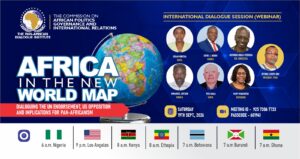
On September 19, 2026, The Pan-African Dialogue Institute (TPADI)—through its Commission on African Politics, Governance, and International Relations—hosted a landmark international webinar titled “Africa in the New World Map: UN Endorsement, U.S. Opposition, and Implications for Pan-Africanism.“ Hosted by Dr. Daniel Umoh and featuring opening remarks from TPADI President Associate Prof. Effiong Udo, the event convened global scholars, policymakers, and civil society leaders to interrogate how cartography, power, and knowledge production intersect to shape Africa’s global standing.
“Decolonization of Africa has to start from the mind.”
— Dr. Daniel Umoh, Webinar Host
The dialogue was sparked by a major geopolitical milestone: on September 4, 2026, the United Nations General Assembly adopted a resolution entitled “Correct the Map: Rebalancing Global Cartographic Representation and Promoting Equitable Representation of the World’s Regions, Particularly Africa.”
-
The Vote Count: The initiative passed overwhelmingly with 164 votes in favor, 1 against (the United States), and 6 abstentions.
-
African Leadership: Spearheaded by Togo on behalf of the African Group and backed by the African Union, the resolution formally challenged centuries of cartographic distortion.
-
The Root Distortion: For over 450 years, classrooms and institutions worldwide have relied heavily on the Mercator Projection (developed in 1569 for European maritime navigation). While preserving angles and shapes for compass navigation, Mercator severely compresses equatorial regions while enlarging landmasses near the poles. As a result, Greenland—which is roughly 2.16 million km2 appears equal in size to the continent of Africa, which is over 30.3 million km2 (more than 14 times larger).
Opening Address by the TPADI President: Mental Decolonization & Knowledge Sovereignty
Setting the tone for the event, the International President of TPADI emphasized in his opening speech that true decolonization cannot stop at political boundaries—it must begin within the human mind[cite: 3]. He highlighted that centuries of historical and cartographic misrepresentation, particularly through tools like the Mercator projection, have subtly distorted global perceptions and systematically undervalued the African continent.
Key highlights from the President’s opening address included:
-
Cognitive Decolonization: True liberation requires dismantling internalized biases and visual distortions created by colonial-era geographical tools
-
Moving Beyond Symbolic Victories: While historic milestones like the recent UN resolution on cartographic justice are vital steps forward, Africa must translate these victories into policy by integrating accurate geographical models directly into national school curricula
-
Reclaiming Knowledge Sovereignty: African institutions and scholars must stop waiting for external validation or relying on foreign frameworks, leading instead in creating indigenous research, tools, and platforms that reflect African realities
Core Panel Perspectives & Insights
1. Spatial Reality and Human Valuation
Dr. Mbuthia ( Kenyatta University, Kenya.) emphasized that cartography directly impacts human perception, stating that “what is visible shifts what is valued.” She explained how Mercator’s mathematical trade-offs preserved scale along latitude lines at the expense of true area representation. Moving forward, adoption of equal-area projections (such as the Gall-Peters or Equal Earth projections) offers a vital technical correction to accurately display Africa’s true geographical footprint.
2. Epistemic Justice & Structural Agency
Prof. Emmanuel Matthew Akpabio ( University of Uyo, Nigeria.)
Prof. Akpabio ( University of Uyo, Nigeria.) framed the issue around representational politics and epistemic justice—asking fundamentally, “Whose knowledge counts?” He observed that map-making has historically been tied to imperial expansion, boundary drawing, and resource extraction. Addressing the U.S. vote, he noted that external powers often treat cartography as a purely technical or geological issue, whereas for Africa, it is deeply bound to power dynamics and symbolic equity. He urged African institutions and the AU not to wait for external permission, but to drive the design and integration of purpose-driven maps into school curricula across the continent.
3. Reimagining Pan-Africanism in a Changing World
Prof. Okorie (University of Uyo, Nigeria) highlighted Africa’s evolving position within the emerging global order, noting that the core issue is no longer whether Africa matters, but whether Africans will remain objects of decisions made by others. Pointing to shifting geopolitical structures—such as the expansion of BRICS to include African nations—he called on the continent to transform its demographic strength, natural resources, and cultural capital into proactive international leverage.
4. The Global Revisionist Movement & Threat to Decolonial Scholarship
Prof. Mutombo Nkulu-Nsengha (Vice President, TPADI) delivered a sharp intervention exposing the concerted global pushback against decolonial scholarship and intellectual liberation. He argued that the U.S. opposition to the UN cartographic resolution is part of a broader, systemic movement designed to maintain the colonization of the mind. Highlighting initiatives like Project 2025 in the United States and state-driven efforts in France to reframe colonial history, he warned against the resurgence of “toxic colonial knowledge.” He emphasized that African intellectuals, educators, and media personnel who challenge these revisionist narratives face severe academic and social targeting, making the collective defense of authentic African scholarship an urgent priority.
Strategic Takeaways for the Pan-African Movement
-
Decolonizing Cognitive Geographies: Misrepresenting spatial dimensions distorts historical memory and self-concept. True decolonization must address educational materials, digital platforms, and visual tools to instill continental pride in future generations.
-
From Symbolism to Structural Power: A UN resolution is an important symbolic victory, but real change requires sovereign action—incorporating accurate cartography into national curricula, research institutions, and continental policy frameworks.
-
Knowledge Sovereignty: African scholars, technologists, and institutions must lead the production of geographical and conceptual tools that reflect African realities rather than relying on external interpretations.
Join the Dialogue with TPADI
The Pan-African Dialogue Institute (TPADI) is an international think tank bringing together academics, professionals, students, and grassroots leaders across Africa and the diaspora. Operating through 10 specialized commissions, TPADI is dedicated to knowledge-driven, non-violent, and broad-based advocacy for continental development.
-
Website: www.africadialogue.org
-
Get Involved: Apply for membership across our workgroups at www.africadialogue.org/membership
Follow The Pan-African Dialogue Institute on social media for upcoming webinars, policy briefs, and community initiatives.